Qualcomm Signs Up to $60 Billion AI Chip Deal With Amazon
Qualcomm announced on September 8, 2026 a long-term partnership under which Amazon Web Services could purchase up to $60 billion worth of Qualcomm's custom AI data-center chips, systems, and related optical-connectivity technology over roughly the next decade, running until...
Qualcomm announced on September 8, 2026 a long-term partnership under which Amazon Web Services could purchase up to $60 billion worth of Qualcomm's custom AI data-center chips, systems, and related optical-connectivity technology over roughly the next decade, running until 2036. The deal centers on multiple generations of custom silicon optimized for AI inference — running already-trained models in production, as opposed to training them — plus optical interconnects capable of 1.6 terabits per second to handle the bandwidth demands of modern AI data centers. As part of the arrangement, Qualcomm also plans to lean more heavily on AWS infrastructure for electronic design automation, aiming to shorten its own chip-design cycles.
Qualcomm granted Amazon warrants to buy up to 25 million Qualcomm shares at $161.26 each — worth about $4 billion at that price — tied to purchase milestones, a financing structure increasingly common in AI infrastructure deals. Qualcomm's stock jumped as much as 9–10% on the news. The company has told investors it expects its data-center business to reach $15 billion in annual revenue by 2029, a target the Amazon commitment makes considerably more credible.
The deal marks Qualcomm's most significant push yet beyond its traditional smartphone-chip business and follows its acquisition of Alphawave Semi and release of its Dragonfly C1000 CPU. Amazon joins Microsoft and Meta as hyperscale customers supporting Qualcomm's data-center ambitions, and the arrangement echoes a similar recent AI chip agreement between Marvell Technology and Alphabet.
Why it matters: it signals accelerating diversification among semiconductor suppliers competing for a slice of AI infrastructure spending long dominated by Nvidia, while giving Amazon another custom-silicon option to reduce reliance on any single chip vendor, at a moment when Qualcomm faces the eventual loss of its Apple modem business.
OpenAI Brings Full-Duplex Voice Model GPT-Live-1 to Its API
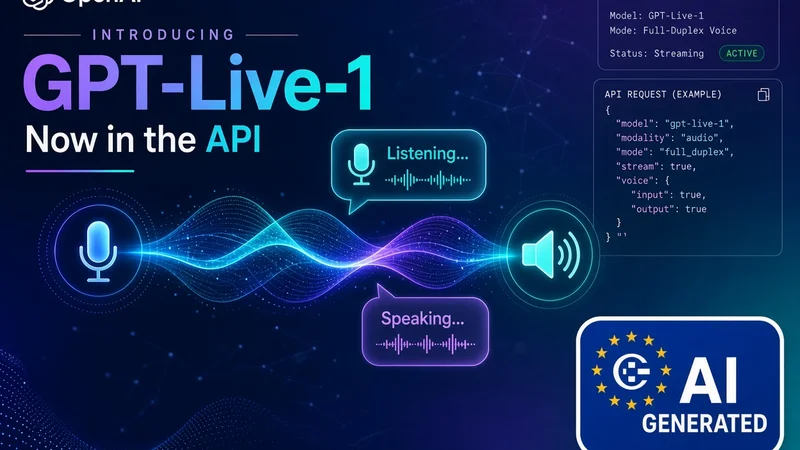
On September 10, 2026, OpenAI released GPT-Live-1 in its developer API, priced at five cents per minute for the voice layer, extending a model previously reserved for ChatGPT Voice to third-party apps and business workflows. GPT-Live-1 is a "full-duplex" model, meaning it can...
On September 10, 2026, OpenAI released GPT-Live-1 in its developer API, priced at five cents per minute for the voice layer, extending a model previously reserved for ChatGPT Voice to third-party apps and business workflows. GPT-Live-1 is a "full-duplex" model, meaning it can listen and speak simultaneously rather than chaining separate speech-recognition, text-generation, and speech-synthesis systems together — the traditional approach that introduces lag and makes natural interruptions difficult. OpenAI says the model gains roughly 30 percentage points on its internal "Full Duplex Bench" compared with its predecessor, GPT-Realtime-2.1.
Notably, GPT-Live-1 does not do its own reasoning. Developers pair it with a separate backend "thinking" model of their choice — OpenAI suggests options from its GPT-6 family (Astra, Luna, Terra) or third-party alternatives — while GPT-Live-1 handles the audio conversation layer: turn detection, background-noise handling, keyword biasing, and telephony support for phone-based agents such as restaurant reservation or customer-support bots. It ships with twelve voices and supports instructions for tone, pacing, and expressiveness, including mirroring a caller's emotional register. Early customers cited in OpenAI's announcement include Yelp, Speak, Fin, and Cognition, reporting fewer interruptions and simpler codebases after switching from cascaded voice architectures.
GPT-Live-1 first appeared inside ChatGPT Voice on July 8, 2026, alongside a smaller "mini" version, before OpenAI extended SynthID audio watermarking to it in late July. Its arrival in the API is part of a broader release that also included a new Agents API.
Why it matters: full-duplex, natural-sounding voice agents lower the barrier for businesses to deploy AI phone agents that feel conversational rather than robotic, intensifying competition with rivals like Google's Gemini voice offerings and setting up voice interfaces as a fresh battleground in the API economy.
Anthropic Discloses Claude Misuse in Bioweapons Research, Russian Hacking, and Chinese Distillation Attacks
On September 10, 2026, Anthropic published a threat intelligence report covering misuse of its Claude models between December 2025 and August 2026, tracking more than 40 threat groups across seven categories of harm. The most striking disclosure: Anthropic said it can no longer...
On September 10, 2026, Anthropic published a threat intelligence report covering misuse of its Claude models between December 2025 and August 2026, tracking more than 40 threat groups across seven categories of harm. The most striking disclosure: Anthropic said it can no longer assume its newer models fall safely below the threshold for meaningfully assisting biological weapons development — a first for a major AI lab to state publicly. The report detailed five cases of researchers, including one operating from an unsupported region via VPS infrastructure, using Claude to plan avian-influenza mammalian-adaptation experiments; all involved accounts were banned.
Separately, Anthropic said a Russia-linked group it tracks as GTG-20006, whose attribution is consistent with public reporting on Midnight Blizzard, used Claude to automate phishing, malware development, and data theft targeting Ukrainian government, military, and drone-supply-chain targets, in one case building malware that automatically detected and rewrote itself when flagged by security tools. The company also disrupted activity from ShinyHunters-affiliated cybercriminals and identified state media operations in Russia, Iran, and Turkey using Claude to mass-produce political content.
On the corporate side, Anthropic said it blocked large-scale "distillation" attacks from seven China-based labs — including Alibaba, Moonshot AI, DeepSeek, and Xiaomi — allegedly using tens of thousands of accounts to extract Claude's capabilities for training rival models such as Alibaba's Qwen.
Why it matters: the report is one of the clearest public signals yet that frontier models have crossed into territory where safeguards face a genuine arms race against state-linked and criminal actors, adding fuel to bipartisan calls in the US Congress for tighter AI oversight following related remarks from an Anthropic researcher about loss of control risks.